Call center metrics to improve performance
Track the right call center metrics and turn insights into better performance with AI-powered analytics.
Call center metrics are essential performance indicators that measure how effectively your contact center delivers high-quality customer experiences, manages operational efficiency, and supports strategic business outcomes.
But tracking dozens of metrics isn’t the goal. The actual objective is identifying the metrics that matter most and knowing how to use them to improve performance.
By organizing key metrics into clear categories and prioritizing the ones that directly impact outcomes, such as customer satisfaction, resolution rates, and cost efficiency, you can make smarter, faster decisions. RingCentral's RingCX platform simplifies this process with pre-built dashboards, unified analytics across channels, and AI-powered insights that turn raw data into actionable improvements.
What are call center metrics?
Call center metrics are measurable data points that reveal how well your team serves customers, where bottlenecks exist, and which areas need improvement.
While the terms “metrics” and “KPIs” are often used interchangeably, there’s an important distinction:
- A metric is any measurable aspect of operations
- A key performance indicator (KPI) is a metric tied directly to business success
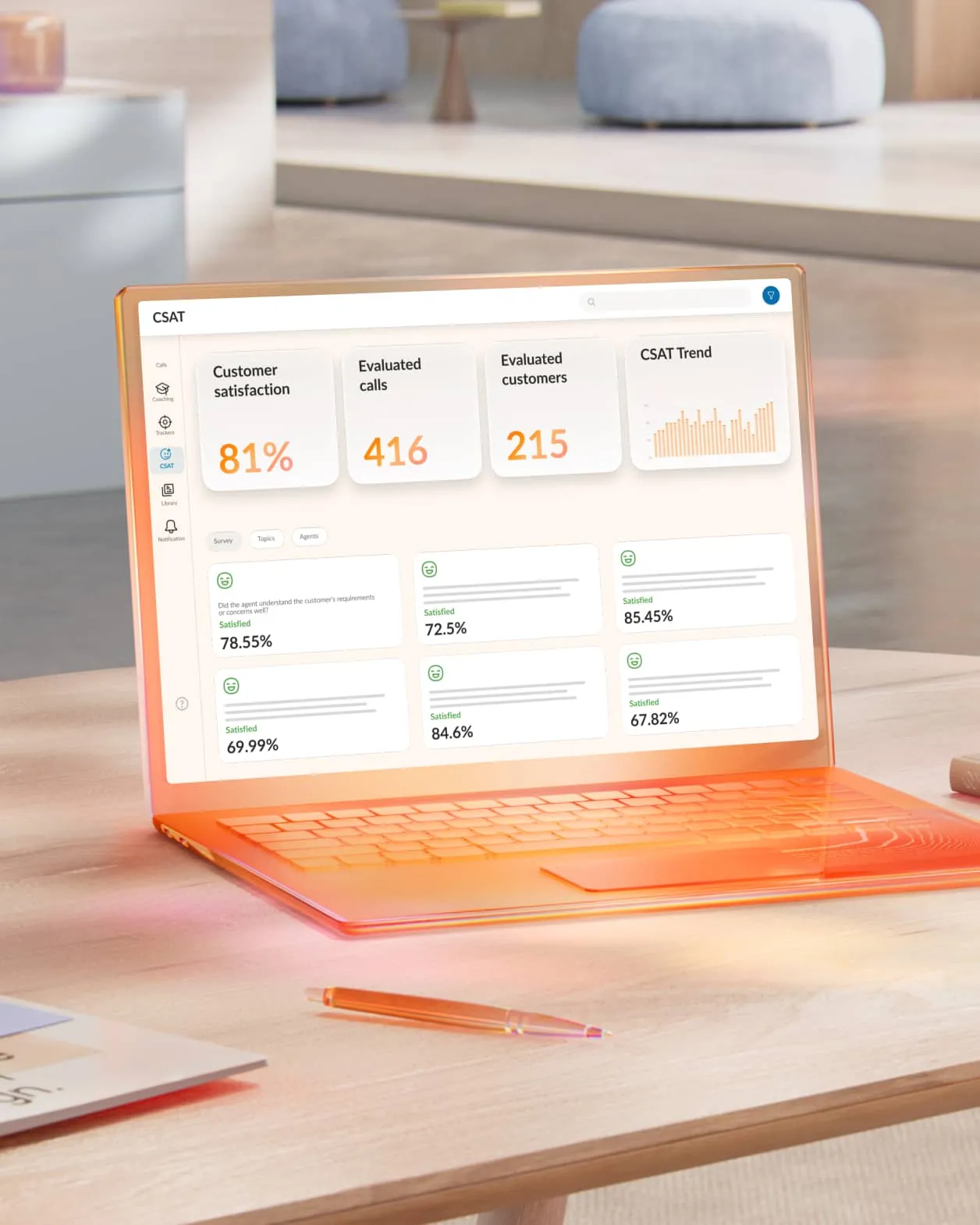
Most call centers track dozens of metrics, but you only need to monitor a handful of KPIs to guide strategic business decisions.
Types of call center metrics
The most effective way to manage performance is to group contact center metrics by business objective. Instead of tracking everything equally, focus on the following four core categories.
Customer experience metrics
To understand how customers perceive your service and whether issues are resolved effectively, monitor:
- First contact resolution (FCR)
- Customer satisfaction (CSAT)
- Customer effort score (CES)
- Net Promoter Score (NPS)
These metrics directly influence retention and brand perception.
Efficiency and cost metrics
To reveal how efficiently your contact center operates and where you can reduce costs, track:
- Average handle time (AHT)
- Cost per call (CPC)
- Agent utilization rate
These metrics impact scalability and average cost.
Operational performance metrics
To identify bottlenecks in queues, routing, and responsiveness, measure:
- Average speed of answer (ASA)
- Average wait time (AWT)
- Call abandonment rate
- Percentage of calls blocked
These metrics highlight staffing and workflow issues.
Agent performance metrics
To show how effectively your agents manage their workload to maintain call center/agent productivity, measure:
- After-call work (ACW) time
- Occupancy rate
- Attrition rate
These metrics reveal the balance between operational efficiency and the agent experience.
Conversation intelligence metrics
To understand the root causes behind your data, track:
- Sentiment trends
- Customer intent patterns
- Conversation quality scores
- Compliance signals
AI-powered analytics (like RingCentral’s AI Conversation Expert) analyze 100% of customer interactions to uncover patterns that manual quality assurance misses.
See how RingCX tracks these metrics
Experience how AI-driven dashboards, summaries, and alerts make it easy to optimize your entire contact center operation.
5 most important call center metrics to track (and how to improve them)
Not all metrics carry the same weight. Prioritizing a small group of call center KPIs ensures you focus on those that drive the majority of your performance outcomes.
The table below summarizes the most important call center metrics, what they measure, and why they matter.
1. First contact resolution (FCR)
FCR measures how often customer issues are fully resolved in a single interaction, and without follow-ups, transfers, or callbacks. Resolving issues on the first attempt is one of the most effective ways to reduce operational costs and improve satisfaction at the same time.
Formula: (Issues resolved on first contact ÷ Total issues handled) × 100
Benchmark: According to recent research, 70% to 79% is good, while world-class performance is 80% or higher.1
How to improve FCR:
- Route customers to the right agent on the first attempt
- Give agents full context with customer relationship management (CRM) platform integrations and interaction history
- Surface relevant answers using AI
AI-powered routing and real-time assistance help agents resolve issues faster without increasing handle time.
2. Customer satisfaction score (CSAT)
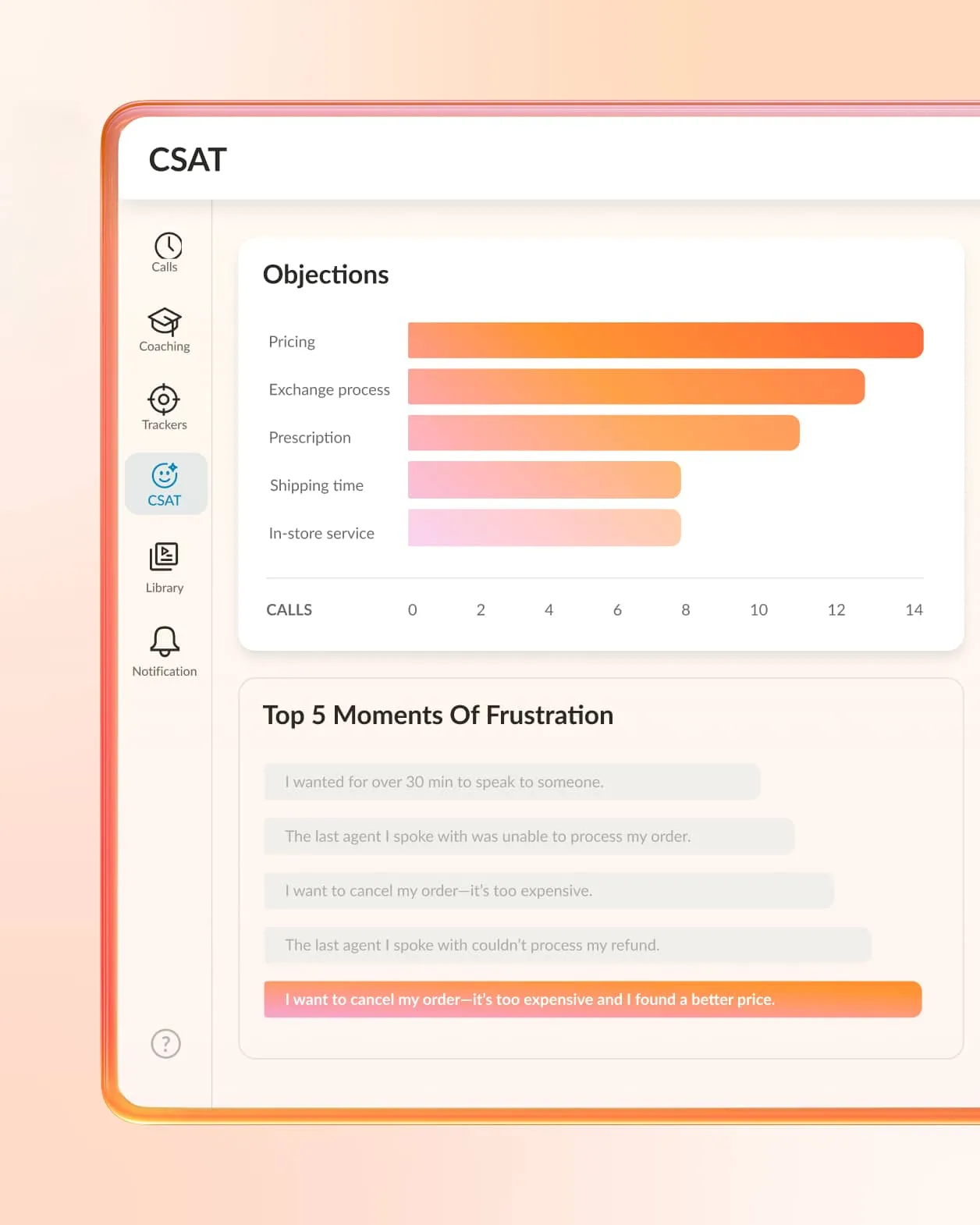
CSAT measures how satisfied customers are with a specific interaction, typically through post-call surveys. It gives you a direct view into how customers experience your service, but it’s most useful when you can pinpoint why satisfaction rises or falls.
Formula: (Satisfied customers ÷ Total survey responses) × 100
Benchmark: The American Customer Satisfaction Index reports that call center satisfaction benchmarks have recently reached 79% to 81% in key service sectors.2
How to improve CSAT:
- Reduce wait times and unnecessary transfers
- Deliver consistent service quality through coaching and QA
- Identify friction points using sentiment analysis and feedback trends
The more visibility you have into each interaction, the easier it becomes to turn insights into better experiences.
3. Average handle time (AHT)
AHT measures how long agents spend on each interaction, including talk time, hold time, and after-call work. It’s essential for understanding efficiency, but speed alone doesn’t equal performance.
Formula: (Talk time + Hold time + ACW) ÷ Total number of interactions
Benchmark: A recent study found that a healthy AHT typically falls between 4–6 minutes for general support and 8–12 minutes for technical issues.3
How to improve AHT without sacrificing quality:
- Automate after-call work with AI-generated summaries
- Equip agents with real-time guidance during interactions
- Reduce repeat contacts by improving FCR
Reducing handle time only works when resolution quality stays high. Otherwise, repeat customer calls increase and so do costs.
4. Call abandonment rate
Call abandonment rate shows how many customers hang up before reaching an agent, which is often a direct signal of frustration. When abandonment rises, it usually points to delays in response or gaps in staffing.
Formula: (Abandoned calls ÷ Total inbound calls) × 100
Benchmark: According to studies, a 2% abandonment rate is considered good, 5% is seen as acceptable, and anything above 5% would be viewed as problematic.4
How to improve:
- Align staffing with peak hours
- Offer callbacks instead of long hold times
- Optimize queue management and routing
Even small improvements here can significantly improve customer experience and reduce lost opportunities.
5. Agent occupancy rate
Agent occupancy rate measures how much of an agent’s logged-in time is spent actively handling interactions or completing related work. It helps you understand workload balance, but pushing it too high can quickly lead to burnout.
Formula: (Handle time + ACW) ÷ Logged-in time × 100
Benchmark: Recent agent occupancy studies found that the ideal occupancy rate falls between 75% and 85%.5 Rates above 85% are generally unsustainable and often lead to mental fatigue and higher attrition.
How to improve:
- Distribute workloads more evenly across teams
- Automate repetitive tasks to free up agent time
- Monitor occupancy alongside CSAT to protect experience quality
The goal is to maintain a sustainable pace that supports both performance and agent well-being.
Why these metrics matter together
Individually, each metric tells part of the story. Together, they give you a complete picture:
- FCR and CSAT measure customer experience
- AHT and occupancy track efficiency and workload
- Abandonment rate highlights operational gaps
The key is to manage them as a system, not in isolation. Unified analytics and AI-driven insights can help you see how changes in one area affect performance across your entire contact center.
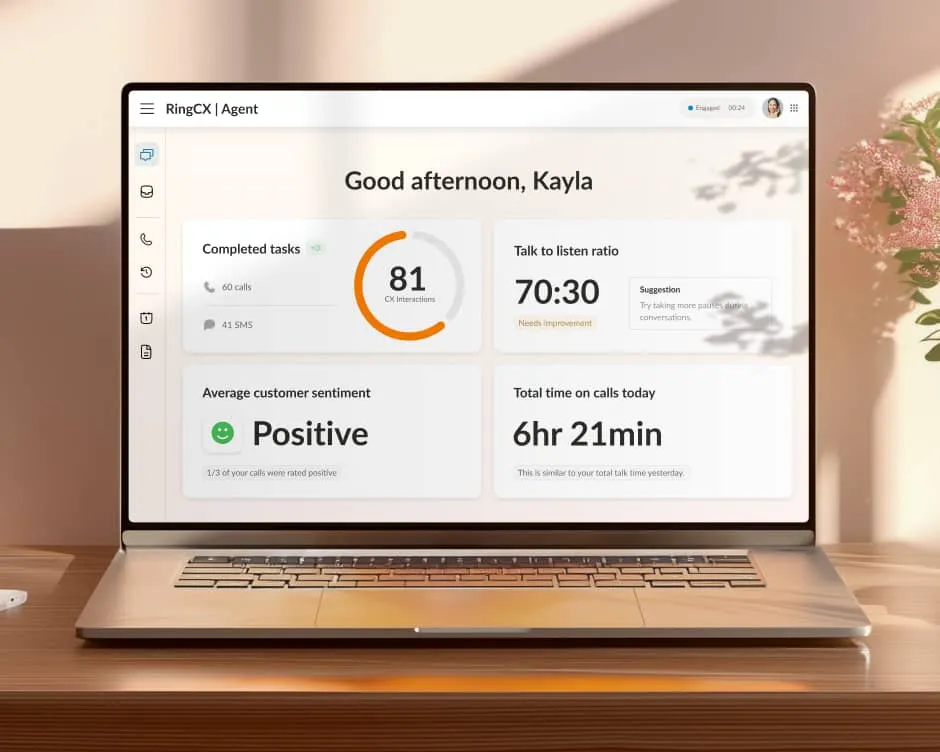
See how our AI Interaction Analytics works
How to balance call center metrics
Optimizing call center performance means managing the relationship between multiple metrics. Because of the natural tension between efficiency and experience, this is often easier said than done:
- Reducing AHT too aggressively can lower FCR and CSAT
- Focusing only on satisfaction can increase costs and strain your team
Most contact centers rely on sampled data and lagging indicators, using traditional metrics that show what happened but not why or how to fix it.
This makes it difficult to:
- Understand the root cause behind metric changes
- Identify issues before they escalate
- Balance competing priorities across teams
As a result, teams end up improving metrics in isolation, which quickly becomes inefficient. Customer-centric contact centers pair metrics together to ensure balanced performance.
For example, this could mean:
- Improving AHT only when FCR remains above target
- Monitoring occupancy alongside CSAT to prevent burnout
- Evaluating abandonment rates alongside staffing and response times
This approach keeps efficiency and experience aligned so improvements in one area don’t create problems in another.
How AI turns call center metrics into action
AI makes it possible to manage these metrics in real time, making the move toward AI-driven models a necessity. According to a 2025 Gartner survey, 91% of customer service leaders face executive pressure to implement AI, with a primary focus on improving customer satisfaction, operational efficiency, and self-service success.6
Instead of relying on partial data, modern platforms like RingCX use AI to analyze 100% of interactions across channels. This gives you a complete, continuous view of performance, turning metrics into signals you can act on immediately:
- Coaching and insights: Agents get guidance to improve outcomes without increasing handle time.
- Full-interaction quality monitoring: AI evaluates every conversation, eliminating the blind spots of manual QA sampling.
- Automated root cause analysis: Algorithms identify why metrics like AHT, FCR, or CSAT are changing, whether due to routing issues, knowledge gaps, or process friction.
- Predictive insights: AI tools surface emerging trends early so you can address issues before they impact customer experience.
This level of insight makes it easier to connect metrics and manage them as a system. For example, if AHT increases, RingCX helps you determine whether:
- Agents are in need of better guidance
- Customers are facing more complex issues
- Inefficient workflows are slowing interactions
Instead of applying a one-size-fits-all fix, you can respond with targeted improvements that protect both efficiency and experience. This allows you to establish a more balanced, responsive contact center where efficiency, quality, and agent experience improve together.
The ROI of our AI Contact Center
How to build a call center metrics dashboard that drives action
A dashboard that only displays data isn't enough. Follow these steps to create a system that triggers decisions and workflows the moment performance deviates.
1. Define metric owners and decision workflows
Without clear ownership, metrics become decorative. Every KPI on your dashboard needs an owner responsible for monitoring it and acting when thresholds are breached. Assign supervisors to real-time operational metrics like active waiting calls and ASA, and designate team leads or managers for daily review of FCR, CSAT, and AHT trends.
Equally important is defining what happens when a threshold is crossed. Document escalation procedures in advance: if the abandonment rate exceeds 5% for 15 consecutive minutes, who gets notified and what actions are authorized? Pre-defined workflows prevent the hesitation that turns a manageable spike into a service failure.
2. Choose your data sources and ensure consistency
Most contact centers pull data from multiple systems—CaaS platforms, CRM tools, workforce management software, and quality monitoring applications—and conflicting metric definitions across these systems often lead to poor decisions.
Establish unified definitions before you build your dashboard. Agree on exactly how each metric is calculated, which system is the source of record, and how data from different platforms gets reconciled. Platforms like RingCX reduce this complexity by consolidating contact center data across voice, digital, and AI-assisted interactions into a single analytics layer with standardized metric definitions.
3. Set up real-time alerts and automated responses
The most effective dashboards go beyond showing problems by triggering corrective actions automatically. Configure alerts that notify supervisors the moment key metrics breach defined thresholds, whether that's an abandonment rate climbing above your service level agreement (SLA) target or ASA exceeding 30 seconds during call volume spikes.
Where possible, automate the response itself. Modern CCaaS platforms can trigger routing adjustments, activate overflow queues, or send callback prompts to waiting customers without manual intervention. This shifts your team from reactive firefighting to proactive management.
What are call center metrics used for?
Call center metrics do more than track performance. They drive data-driven decisions across staffing, budgeting, and customer experience.
Process improvement is another core use case. Tracking average age of query alongside repeat call rates helps you identify issue types that consistently escape first-contact resolution. These trends point to knowledge gaps, agent authority limitations, or process bottlenecks that agent training alone won't fix.
According to McKinsey, AI adoption in business functions has reached 88% of organizations.7 Contact centers are increasingly using AI-powered analytics to predict future demand and proactively adjust operations before problems arise.
Track and improve call center metrics with RingCX
Managing call center performance across disconnected tools creates delays, inconsistencies, and missed insights.
RingCX brings everything together, consolidating omnichannel data, AI-powered analytics, and real-time dashboards into a single platform. Instead of reacting to metrics after the fact, you can:
- Identify issues as they emerge
- Understand root causes instantly
- Improve performance across every interaction
From reducing after-call work with AI summaries to improving FCR through intelligent routing, RingCentral helps you translate metrics directly into better customer experiences and lower operational costs.
Sources
1. First call resolution (FCR): A comprehensive guide. SQM Group. (n.d.).
2. Rizzo, C. (2026, February 3). Press Release: Retail and consumer shipping study 2026. The American Customer Satisfaction Index.
3. 25 call center metrics for QA managers. Gistly. (n.d.).
4. Pearce, J. (n.d.). How to measure call abandon rate. Call Centre Helper.
5. Understanding agent occupancy for modern call centers. Metropolis Corp: UC Analytics, CDR, Call Reporting & Contact Center Solutions. (n.d.).
6. Press announcement: Gartner Survey finds 91% of customer service leaders under pressure to implement AI in 2026. Gartner. (2026, February 18).
7. Singla, A., Sukharevsky, A., Hall, B., Yee, L., Chui, M., & Balakrishnan, T. (2025, November 5). The state of AI in 2025: Agents, Innovation, and transformation. McKinsey.